
The homes in Nashville, IN sit on a foundation of wood-frame construction, most of them built in the fifties through the seventies, with panels and wiring that were sized for a fraction of what a household runs today. The network of electrical contractors in Bloomington reaches these houses daily, and a local electrician familiar with professional electrical panel upgrade work understands exactly what an older fuse box or undersized breaker box means for a home like this.
Homeowners here call a local electrician rather than a general one because the work inside these houses rewards someone who has opened the same walls and traced the same wiring before.
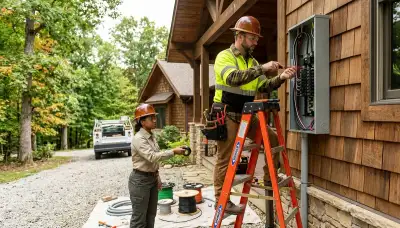
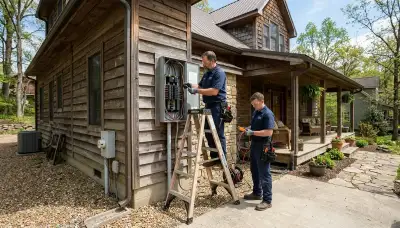
What a Local Electrician Knows About Nashville Homes
A local electrician working in Nashville, IN recognizes that houses built in the fifties and sixties were wired for a load that did not include central air, multiple refrigerators, or a car charger in the garage. That gap between original capacity and current demand is where most of the work begins.
These homes most often need panel work and circuit additions, two jobs that look straightforward until the electrician opens the box and finds a fuse panel with no room left, or traces a circuit through a crawlspace rather than a clean basement run. Homeowners in Morgantown, IN face similar situations in houses of the same era.
If an outlet feels warm, a breaker will not reset, or lights dim when a large appliance starts, get it looked at before the problem grows into something more serious.
Electrical Work Matched to How Nashville Homes Are Built
An approach that works in a newer slab-on-grade house does not transfer cleanly to a wood-frame home with a crawlspace and a panel tucked into a utility closet. Running a new circuit through a crawlspace takes longer and requires different access than dropping one through an open basement.
Nashville homes come in a few distinct forms: older wood-frame houses on crawlspaces where new wiring means working low and tight, homes with full basements where the panel is accessible but the runs are long, and a smaller number of attached houses where shared walls limit where conduit can travel. Each one changes the job. A reliable ceiling fan installation in a house with a finished ceiling, for example, takes more time than the same task in an open-framed space.
Across Nashville homes, four kinds of work come up most: expert home electrical inspection for houses changing hands, quality GFCI circuit installation near water, specialist generator installation for homes that need backup power, and professional electric car charger installation for garages that were never wired for that load.
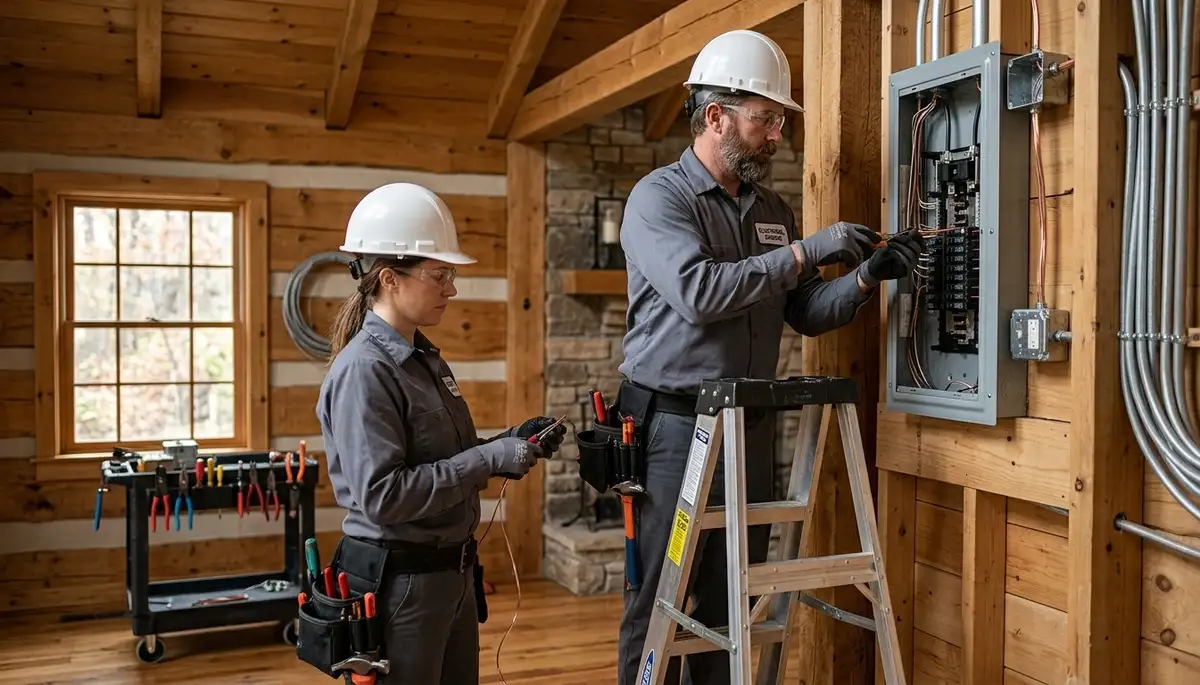
When Nashville Homes Were Built Still Shapes What They Need
Most of the houses in Nashville, IN went up in the fifties and sixties, a period when a standard residential service carried sixty to one hundred amps and wiring ran without a ground wire. Three things follow from that: the panels were never sized for modern loads, the outlets in most rooms are two-prong, and the connections at switches and fixtures have been under stress for decades.
The Panel Has No Room Left
A homeowner opens the breaker box to add a circuit and finds every slot occupied, or worse, finds a fuse panel that has not been touched in forty years. A full panel cannot absorb a new circuit safely, and doubling up breakers is not a correction.
Local electricians replace the panel or add a subpanel to create the capacity the house actually needs. The fix gives the home room to grow without the homeowner managing around a box that was already full. Homeowners in Spencer, IN deal with the same panel limitations in houses from the same era.
Outlets That Are Only Two-Prong
A house full of two-prong outlets tells the homeowner that the wiring behind the walls was installed before grounding was required. Adapters do not solve the problem; they only hide it. Ungrounded circuits leave appliances and electronics without a safe path for a fault.
Local electricians run a grounding conductor to the affected circuits or install the outlets with test and reset buttons where code allows it as a replacement method. Either way, the homeowner stops relying on adapters and the circuits perform the way a modern outlet should.
Connections That Have Carried Heat for Decades
In homes built in the late sixties and into the early seventies, aluminum wiring was common in branch circuits. Aluminum expands and contracts differently than copper, and after decades of use the connections at outlets and switches loosen, creating resistance and heat. An outlet warm to the touch is the sign a homeowner can feel.
Local electricians install approved connectors at every aluminum-to-copper junction and inspect each device box for signs of heat damage. The two things that improve immediately are the safety of the connection and the stability of the circuit under load.
A Service Sized for a Much Smaller House
A car charger, a new air conditioning unit, or a shop in the garage adds a load the original service was never asked to carry. On a hot afternoon when the air conditioning runs hard, the added draw can push the panel past what it can handle without tripping.
Adding capacity means upgrading the service entrance and replacing the panel with one sized for what the house actually runs. Afterward the homeowner can charge a vehicle, run the air conditioning, and use the kitchen at the same time without watching the breaker box.
Crawlspace Access Slows Every New Circuit
In a Nashville home built on a crawlspace, running a new circuit from the panel to a room at the far end of the house means working in a low, tight space rather than walking a clean basement. The physical constraint adds time and sometimes requires opening a section of wall or ceiling to complete the run.
Local electricians plan crawlspace jobs around the access points that already exist, use flexible conduit where the path bends, and patch only what needs to be opened. The homeowner gets the new circuit with the least disruption the layout allows.
To arrange a no-pressure visit with a local electrician who knows these houses, call (812) 871-4050. A walk-through takes less time than a repair that waited too long.
On Call Electrical brings work that holds to every Nashville home it serves.

Full Electrical Services Available in Nashville, IN
The work below covers what homeowners in Nashville, IN ask for most. Find the item that matches what the house needs and call to talk through the details.
Urgent Electrical Repairs for Nashville, IN Homes
- Electrical repair for a breaker that trips and will not reset, leaving a room or appliance without power
- Outlet repair when a receptacle stops working, feels warm, or shows scorch marks around the face
- Switch repair for a switch that sparks, buzzes, or no longer controls the fixture it is wired to
- Smoke detector installation to replace detectors that are past their service life or missing from required locations
- Fire alarm installation when a house needs a system rather than individual battery units
These are the calls that should not wait. A local electrician can assess the problem the same day in most cases.
Panel, Service, and Wiring Work in Nashville, IN
- Electrical panel upgrade when the breaker box is full, uses fuses, or cannot carry what the house runs today
- Electrical panel installation for a house that needs a new box rather than a retrofit of the old one
- Electrical service work at the point where the supply enters the house and feeds the panel
- Electrical wiring replacement or extension in a house where the original conductors are undersized or deteriorating
- New construction wiring for an addition, a detached garage, or a finished basement being brought into the house
Houses built in the fifties and sixties were wired for a load that did not include the appliances, chargers, and systems a household runs now. Bringing the panel and wiring up to that demand is the work that changes what the house can do.
Safety and Protection Services in Nashville, IN
- GFCI outlet installation in kitchens, bathrooms, and anywhere water and electricity share a space
- Whole home surge protection to guard appliances and electronics from voltage spikes that travel through the panel
- Lightning surge protection for a house exposed to direct strikes that can destroy connected equipment
- Home electrical inspections before buying, selling, or renovating a house where the wiring age is unknown
- Home energy audit to find circuits and devices drawing more than they should and costing more each month
An older home carries risks the homeowner cannot see from the living room. A local electrician can walk the panel, the outlets, and the visible wiring and tell the homeowner exactly what is working, what is marginal, and what needs attention before it becomes a repair call. The inspection covers the panel, the grounding, the outlets near water, and the connections at fixtures and switches.
Lighting, Outdoor, and Added-Load Work in Nashville, IN
- Landscape lighting installation for a yard where the existing outdoor circuit was never sized for a full lighting run
- Security light installation at entry points and along the perimeter where a dedicated circuit is needed
- Electric car charger installation in a garage that was never wired for a dedicated high-draw circuit
- Ceiling fan installation in rooms where the existing box is not rated for a fan and the wiring needs to be confirmed
- Recessed lighting installation in a finished room where new fixtures require running wire without opening every ceiling
These are the jobs that come up when a homeowner adds something to the house the original electrician never planned for. A local electrician sizes the circuit for what is actually being installed and makes sure the panel can carry it without affecting the rest of the house.